Value-Added Tax (VAT) Explained: How the World Taxes Consumption
Learn how Value-Added Tax (VAT) works, how it differs from American Sales Tax, and the math behind extracting VAT from a grand total.
Instantly extract or add VAT to any price tag using our VAT Calculator, or read on to understand the complex global mathematics of consumption taxes.
If you travel outside the United States, you will almost never see "Sales Tax" added to your receipt at the cash register. Instead, over 170 countries around the world (including the entire European Union) use a system called Value-Added Tax (VAT).
While both are taxes on consumption, the mathematical implementation of VAT is drastically different from the American system.
Sales Tax vs. VAT
The American Sales Tax Model: Sales tax is a single-stage tax. The government only collects the tax once, at the very end of the supply chain, directly from the final consumer. If a shirt is $100 and sales tax is 10%, the consumer pays $110 at the register. The store sends that $10 to the government.
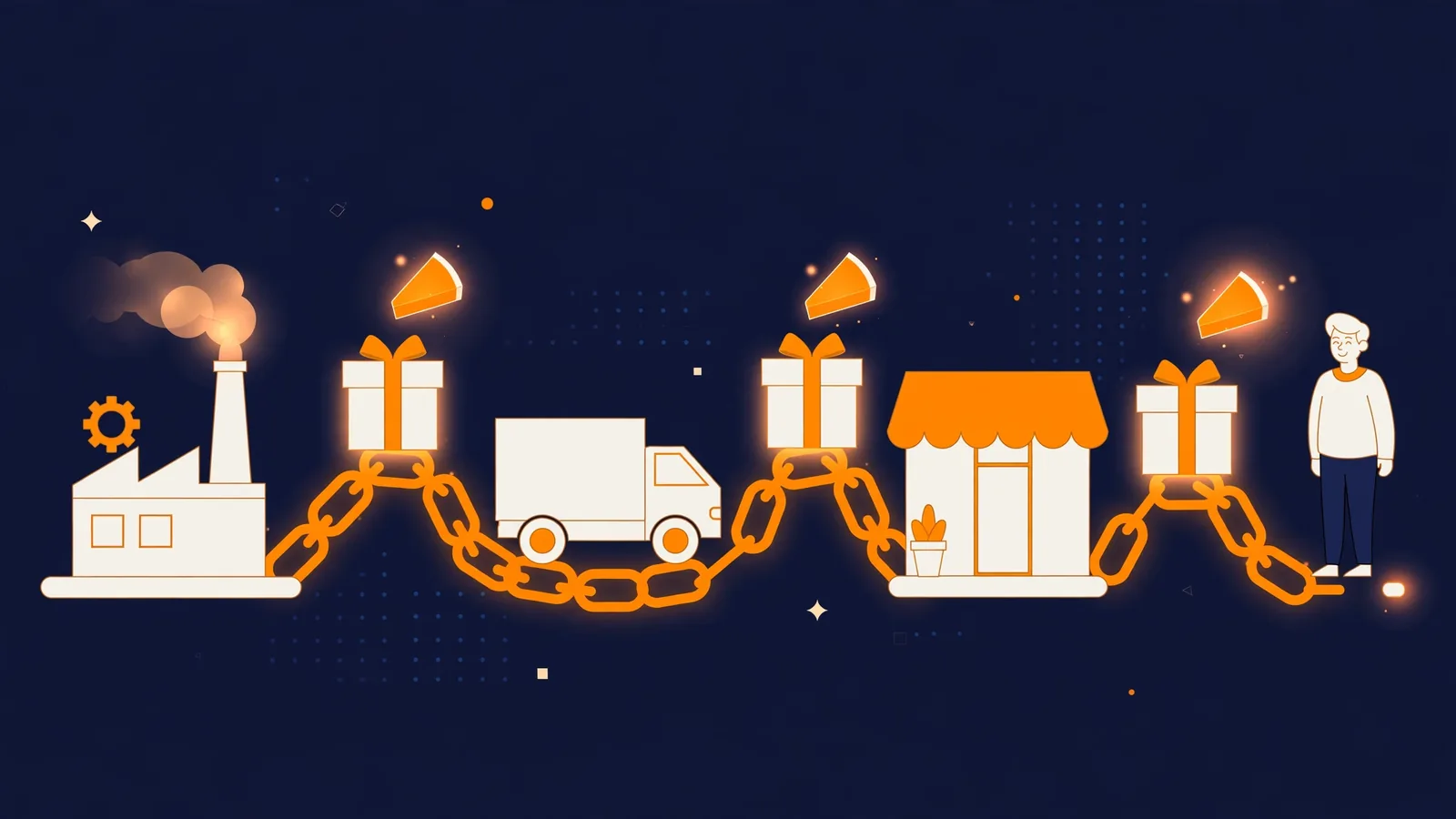
The Global VAT Model: VAT is a multi-stage tax. The government collects a mathematical percentage of the tax at every single stage of production—from the raw material supplier, to the manufacturer, to the wholesaler, and finally to the retailer.
However, at each stage, the business gets to mathematically deduct the VAT they already paid on their materials. This ensures that the tax only applies to the "Value Added" during their specific step.
Ultimately, the final consumer still bears 100% of the total tax burden, but the government has collected the money in dozens of tiny, incremental payments along the way.
Enter your own numbers and see the result instantly — free, no signup.
How the VAT Chain Works, Step by Step
The cleanest way to understand VAT is to follow one product through the chain. Imagine a chair moving from raw materials to a store shelf, in a country with a 20% VAT rate.
Stage 1: The Supplier
A lumber supplier sells wood to a furniture maker for a net price of €50. VAT adds 20%, so the invoice total is €60.
The supplier sends the €10 of VAT to the government. This is the first slice of the tax.
Stage 2: The Manufacturer
The furniture maker builds a chair and sells it to a retailer for a net price of €120. With 20% VAT, the invoice total is €144.
The manufacturer collected €24 of VAT on the sale. But it already paid €10 of VAT on the wood, so it deducts that credit.
The manufacturer sends only the difference, €14, to the government. That €14 is exactly 20% of the €70 of value it added.
Stage 3: The Retailer
The retailer sells the chair to you for a net price of €200. With VAT, you pay €240 at the register.
The retailer collected €40 of VAT, deducts the €24 it paid on its purchase, and sends €16 to the government.
The Totals Always Match
Add up what the government received: €10 + €14 + €16 = €40. That is exactly 20% of the final €200 net price.
You, the consumer, paid the full €40 tax. The businesses merely collected and forwarded it in slices.
This self-policing paper trail is why governments like VAT. Every business in the chain demands a proper VAT invoice so it can claim its credit.
VAT is Inclusive (The Hidden Tax)
The most noticeable difference for a consumer is that VAT is almost always inclusive.
In the US, if a price tag says $100, you have to do mental math to figure out what the final price will be after tax. In a VAT country (like the UK), if a price tag says £100, you pay exactly £100 at the register.
The VAT (currently 20% in the UK) is already mathematically baked into that £100 price tag.
Standard VAT rates differ widely by country. Within the European Union alone, standard rates commonly run from 17% to 27%, and many countries apply reduced rates to essentials like food, books, and medicine.
Because the rate changes at every border, travelers and online sellers must constantly convert between net and gross prices.
The Math: Extracting VAT from a Price
Because VAT is inclusive, businesses constantly need to extract the VAT amount from their gross sales to know how much money they actually owe the government.
Many people make a catastrophic mathematical error here.
If the inclusive price is £120, and the VAT rate is 20%, people assume the tax is £24 (120 × 0.20 = 24). This is completely wrong.
You cannot multiply the final price by the VAT percentage because the final price has already been inflated.
The Correct Extraction Formula
To find the original base price before VAT was added, you must divide the grand total by (1 + VAT rate).
Example Calculation (20% VAT Rate):
- Inclusive Price: £120
- Formula:
£120 / 1.20 = £100
The original base price was £100.
The VAT paid was £20.
100 + 20 = 120.
If a business owner accidentally used the wrong math (multiplying by 0.20), they would send the government £24 instead of £20, losing 4% of their pure profit margin on every single sale!
The Reverse Direction: Adding VAT to a Net Price
Sometimes you start from the net price and need the shelf price. That direction uses simple multiplication.
Formula: Gross Price = Net Price × (1 + VAT rate)
Example (20% VAT Rate):
- Net Price: £100
- Formula:
£100 × 1.20 = £120
Notice the symmetry: multiplying by 1.20 adds the tax, dividing by 1.20 removes it. The mistake in the section above comes from mixing the two directions.
A Second Worked Example at 25%
Some countries use a 25% standard rate. Suppose a gross price is €100 at 25% VAT.
- Net price:
€100 / 1.25 = €80 - VAT portion:
€100 − €80 = €20
A quarter rate does not mean a quarter of the shelf price is tax. Only €20 of the €100 is tax, because the tax was calculated on the €80 base.
For larger amounts the same division applies. A gross price of €250 at a 20% rate contains a net price of €208.33 and VAT of €41.67.
A Quick Shortcut for the Tax Portion Only
If you only need the VAT amount, multiply the gross price by rate / (1 + rate).
At 20%, that fraction is 0.20 / 1.20 = 1/6. So the VAT inside any 20% gross price is exactly one-sixth of the total.
£120 × 1/6 = £20. Once you see it as a fraction, the extraction stops feeling like a trick.
If percentage math like this trips you up in general, our Percentage Calculator handles the underlying operations step by step.
VAT for Online Sellers and Freelancers
Selling digital products across borders adds one more twist: the rate that applies is usually the customer's country's rate, not yours.
A freelancer in Germany selling a design template to a customer in Sweden generally charges Swedish VAT on that sale. The seller then reports it through a simplified cross-border filing system rather than registering in every country.
This is why checkout pages ask for your location before showing a final price. The geography determines the rate, and the rate determines the gross total.
Common VAT Mistakes
- Multiplying the gross price by the rate. This overstates the tax every time. Always divide to extract.
- Mixing currencies and rates. A price that includes 20% UK VAT cannot be re-based with another country's rate until the UK tax is removed first.
- Forgetting reduced rates. Food, children's clothing, and books carry lower or zero rates in many countries. Applying the standard rate inflates your numbers.
- Rounding every line differently. Small rounding gaps between invoices are normal, but inconsistent methods create reconciliation headaches at filing time.
- Assuming businesses keep the VAT. They do not. A registered business is a collection agent: it holds the tax briefly, deducts its input credits, and forwards the rest.
FAQ
Can tourists get a VAT refund? Yes. Because VAT is a consumption tax meant for citizens utilizing government services, foreign tourists who buy goods and take them out of the country can often claim a "VAT Refund" at the airport.
However, calculating the refund is complex, as refund agencies usually deduct a massive processing fee (often 30-50% of your total tax refund) before handing you the cash.
Does the business pay VAT out of its own pocket? No. A VAT-registered business charges VAT on its sales and reclaims VAT on its purchases. Its own profit is calculated on net prices. Only the final consumer, who cannot reclaim anything, truly pays the tax.
Why do receipts in VAT countries show a tax breakdown? Because the net price, the rate, and the tax amount must be documented for the credit chain to work. The breakdown on your receipt is the same data the retailer uses in its own VAT return.
Is VAT the same as GST? Very close. Goods and Services Tax (GST), used in countries like Canada, Australia, and India, is built on the same multi-stage, credit-based idea. The math of adding and extracting the tax works the same way.
Don't destroy your profit margins with bad math. Add or extract complex tax rates instantly using the CalcUnit VAT Calculator.